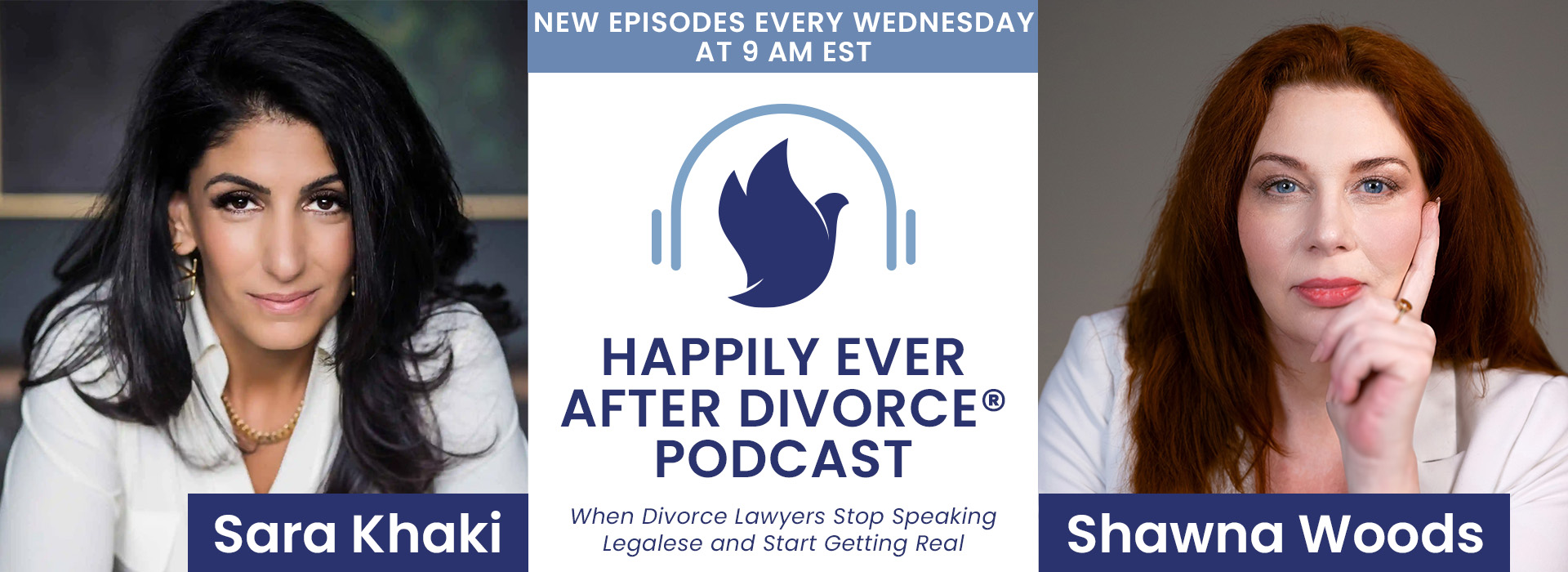
Empowered people make informed decisions that lead to living a life without regret. This is Sara Khaki and Shawna Woods from Atlanta Divorce Law Group. And this is the Happily Ever After Divorce Podcast. Welcome to the Happily Ever After Divorce Podcast.
SPEAKERS
Sara, Shawna
sSara (00:05)
Empowered people make informed decisions that lead to living a life without regret. This is Sara Khaki and Shawna Woods from Atlanta Divorce Law Group. And this is the Happily Ever After Divorce Podcast. Welcome to the Happily Ever After Divorce Podcast. This is Sara Khaki with the Atlanta Divorce Law Group and I’m joined by our managing partner Shawna Woods. Shawna, this is a hot topic and it brings up so much. So let’s get ready to go. This is on financial infidelity.
What is financial infidelity? Well, it’s when two people in a partnership who manage a household together or manage money together are not being honest with each other about what is coming in and what is going out and they’re hiding spending from each other, hiding assets from each other and just not being truthful and having a real partnership about their relationship with money.
Dive a little bit deeper on how we see this coming.
sShawna (01:08)
We see this manifest itself in several different ways. One of the ways that we often see manifest is that somebody will be spending money on things they’re not sharing with the other person. It could be nefarious things. They could be spending it on an affair partner. A lot of times what we see from some clients is they’re sending it overseas to family members without their partner’s consent.
And this is we’re talking about in infidelity is without their partner’s consent, they’re doing things with their money that is family money. And I wanna be very clear when we’re talking about this, because a lot of people come in the misconception of your money, my money, right? And in our worlds, when a marriage dissolves, the first thing I say, it does not matter who earned the money, the assets and debts are all marital, right? With very few exceptions, but.
So we’re talking about doing things that the other person owns part of and taking them and doing something that they would not, they don’t know about, and most of the time they wouldn’t approve of. So that’s one way of financial infidelity. Another way that we often see is hiding of the assets. Either I’m thinking about a divorce and I want to put some funds aside that not necessarily to prepare.
Right, for the eventuality me moving or leaving the situation, but to try to hide them as if they didn’t exist. Right. Right. So that I don’t have to share them, you know, in the solution. So those are two very common ways that we see financial infidelity. Can you think of others?
sSara (02:47)
Yeah, I mean, think these are very, Sean, the one you’re touching upon are the very common ones in divorce law and that become into actionable things that we do for the case. I’m also thinking about the gray area, right? Like the gray area of hiding spending. And this is very, very common amongst women, especially, right? Where they want to spend money on
sShawna (03:10)
Come in.
sSara (03:15)
The injections, they want to spend money on luxury items, spending that they know their partner would not necessarily approve. I don’t want to be sexist. It could also very much happen that the husband has spending that they want to do, that they… Because very often also happens that she is the tighter one on the budget and he’s the one that likes to spend. But one party is the overspender and starts hiding how they’re spending.
And it’s accruing a lot of debt, retail cards, credit cards, or borrowing money. One of our good family friends is a wealth manager and he’s, this is so funny. He calls it using PayPal and Venmo to, what is it called?
sShawna (04:04)
Can I what you’re doing?
sSara (04:05)
Hide
What you’re doing is a money launderer money launderer. It’s so funny. He’s like, you know Two women will go to lunch together one pays for the whole lunch and then the other one ends up owing the other one hundreds of dollars for a $20 lunch. That’s money launderer through Venmo or PayPal So and these are I mean we laugh about it, but because there’s truth to these things
sShawna (04:29)
Because
You went to lunch at Louie
sSara (04:30)
You went
To lunch, I believe it’s on or somewhere where you didn’t want somebody to know where you went to lunch. But it’s these little sneaky things that happen, right? It’s the sneaky ways of one party trying to get away with spending that they don’t want to share with the other person. The asset one is the same thing where one party has money coming in, sources of funds coming in, or has a secret stash of a saving that they don’t want the other person to know.
Sometimes it’s to prepare for divorce or for a worst case scenario. Sometimes it’s not that it’s just because they don’t trust the other party to know about money. I hear this a lot where I’m just kind of putting money aside because he’s such a spender and if I don’t put something away, we’re not going to have anything for a rainy day. So this is more the gray area where things are okay. Things are functioning, but I believe we have a symptom.
Of a bigger issue happening here, something that could later on grow into a bigger disease into the marriage.
sShawna (05:37)
Absolutely, when the very term infidelity that we’re using, know, financial infidelity, the underlying thing is dishonest. Yes. Right. We are not being honest about what we’re doing with our money. And at the heart of it, you know, when we talk about money, that is a lot of times the very essence of all sources of dispute in a relationship, because there never seems to be enough to go around. Especially if you have
What her person who is the primary breadwinner and they may feel entitled to more of the money and more of the spending because they are out there earning the money. And that’s not necessarily mean they’re doing the vast majority of the work in the relationship. A lot of times it is not the breadwinner who’s carrying you the children and the household and all of these other things. So I think at the heart of it really is it’s a level of dishonesty.
Absolutely. Comfortable are you going to be with thinking, okay, he’s just going to spend it, so I’m going to hide it. Right. What kind of dynamic or relationship are you setting up?
sSara (06:47)
Well, I think this goes back to conversations we’ve had in the past about telling the truth and receiving the truth. The person who, I think the bottom line is the money is a symptom of a bigger issue. Right. And what could that bigger issue possibly be? Even whether we’re talking in the sort of like the gray, more micro examples that I’m giving versus the bigger, when it blows up to be the bigger problems that are now
Actionable problems we’re having in a divorce case like the ones you described in the very beginning. Think the bigger symptom is there is either party has some sort of a need that they are not verbalizing to the other person. And it takes two to create a wonderful marriage and partnership. And it takes two to chip at it and ruin it and mess up a partnership or marriage. So
The person who has a need for certain amount of savings, have they stood up for that need and have the other partner received hearing that need and be a partner to provide that need? Okay, I understand you need to have some sort of a mental peace. Need to create a nest egg. You want to have a nest egg or overspender. What need are they fulfilling?
By spending in the dark or spending on items that may or may not be approved by the other person, right? What need do you have for whatever the money’s going towards that you’re not discussing? And can your partner receive hearing that you have these needs, right? And then the extreme cases that you’re talking about where there’s gambling.
There’s people that spend money on strip clubs, because that’s a lot of cash, because cash is easily hidden, right? Or this is one that we see a lot, is the crazy tax bill that’s being hidden from the other spouse, right? Yeah.
sShawna (08:54)
Yeah.
There’s a lot of times that if you’re embarrassed at how you’ve spent your money or if you’ve gotten in trouble with the IRS, so you’re not accounted appropriately, then you don’t want to share that embarrassment. You don’t want to be shamed from your partner. So I do think those are the sometimes the things that they do hide.
One of the things that we are seeing very common of hiding money and hiding funds because really we all use bank cards for the most part, right, instead of cash. So one of the things that I see is there’ll be a really large grocery bill. Really? That’s right. Well, the grocery, the eggs are really went up, you know, and what they’re doing is going and buying these gift cards. Yeah. Right. And so that’s one of the ways of financial availability where you
sSara (09:35)
Yeah
sAsking for the cash back.
sShawna (09:47)
Asking for the cash back, something along those lines so that you can use them.
sSara (09:52)
More money laundering according to our friendly wealth manager.
sShawna (09:55)
Absolutely, we’re money laundering through Venmo and all of these other things, I think people have to have these conversations before they get married. Yes. You see so often the spenders and the savers marry each other and then wonder why they’re not getting along. Yes. So having a really good frank conversation about money and about how you’re treating money and how we expect to, where are we going? Yes.
Family goals with this money, what are our retirement goals with this money, do we want to leave something to next generation? All of these conversations need to be had prior and if they haven’t, you probably should start having them now.
sSara (10:40)
So this is so key, the conversation before getting married and it’s never too late to have it during marriage either. The symptom of the needs that money provides goes back even further, goes back to your family money story. We all have some sort of a relationship with money. And that’s where the, you mentioned the shame. That’s where the shame comes from, right? Some people feel
Certain amount of shame if they go above a certain amount of income. And some people feel certain amount of shame when they go below a certain amount of income. And that all really is a family story of how money was talked about around you, what the family taught you about your relationship with money. There are people who, when things get tight, feel more rich when they spend more. They almost use money to feel more rich.
And then there are people when things get tight, they can’t even spend to produce more. Like their safety is specifically tied to the actual money. The money is not providing either one. It’s not providing the wealth and it’s not providing safety, but it’s a emotional money story that’s driving the entire behavior. And then when you marry these two together, the overspender is threatening the security of the saver.
And the saver is making the overspender feel the lack of worth because they don’t feel rich.
sShawna (12:15)
Absolutely. When you’re saying there’s people who spend everything they have to make themselves feel wealthier. My mom kind of had that relationship with money and because of her mental health issues she really didn’t understand it as well. And my parents themselves had these cons about you know where did the money go? My dad was like where did the money go?
That was always the question and she did not want to be honest. It wouldn’t be things that weren’t even that nefarious of the, she took the kids out to eat instead of cooking dinner. And it is these kind of conversations that are important. And when that happens, like you said, when you’re a child, you learn really quickly which parent you kind of are associating with, which ones feel safer for you with your own fun.
Right? And mixing funds is always such a delicate conversation anyway because a lot of times now we do have these two dual income households and we feel some ownership over, you know, the money that how we want to spend it and what we want to do and we’re joking about the women in Louis Vuitton and doing those type of things. Well, men, I’m gonna tell you they’re just as bad with their golf game. And I’m not talking to you, Hisham.
Or whatever else it is, you know, they happen to be their passions as well. And I, my recommendation has always been to have at least three accounts. You have your account, you have your spouse’s account, and then you have the joint account. And those two accounts, those are your discretionary spend. And you agree what to put in there. And I think that may help some people who have that need to spend on whatever it is they want. It doesn’t matter.
If you want chocolate ice cream, go buy chocolate ice cream. The point is you have that ability to make those decisions without asking, right? But you also have maybe an agreement that says, if a spin goes over X amount, that’s a conversation.
sSara (14:17)
Conversation and that removes the dysfunction of your money story bleeding into your marriage. The other part to the dysfunction of the money story bleeding into your relationships is your relationship with money is also somewhat tied to your relationship with others. Some were taught by their parents that they can be controlled with money, right? They believe that money can be used for a source of control. And we see that.
And a lot of spouses that keeps the other spouse completely in the dark. It doesn’t let them know anything about what’s going on in the finances, what’s going on in assets. And we meet with this new client who’s telling us, I know there might be millions. I don’t know where it is. Don’t know anything. He or she’s done a really good job of keeping me in the dark. And I get the spend. And you can tell this person.
Is so fearful of the future of moving into the unknown because this mystery of where the money is or isn’t has been a form of controlling.
sShawna (15:28)
Absolutely. And a lot of times what I hear is how it started out as loving or at least presented as loving. You don’t need to work. I earn enough money. I would really prefer it if you were able to follow your passion project or if you were able to stay home with the kids, right? And by setting up these dynamics by saying, well, you don’t need to do that.
And now you only have the card that’s in the other person’s name and you only have access to funds that they provide to you. It really does set up a dynamic of, like you said, control, right? Which control often leads to abuse, right? And financial abuse is something we’ve talked about and probably will talk about again. And I do think that also is a type of infidelity, right? The first conversation that I had with someone like you said that that’s like, I really don’t know.
What’s out there is have they worked with a financial advisor? Have their spouse worked with a financial advisor? Do you have access to that financial advisor? Can you ask your spouse, hey, I would like to meet with the financial advisor and understand our finances. And if they’re resistant to that, that’s a huge red flag and a huge question.
sSara (16:45)
I also think the other person who hasn’t engaged in the money story with the spouse who is controlling the finances needs to look inward on this too because there’s also a money story that’s driving that. There’s a lot of people that grow up and just dig their head in the sand and even as a young adult they never have to budget, they never have to take care of anything. They might have had parents that took care of everything and then once they got married the parent removed themselves, the spouse
Plug themselves in. They always want to position themselves in a place where they say, I just don’t ever want to worry about money. I don’t care if you’re Bill Gates, you don’t get the luxury to say, I don’t ever want to worry about money. You need to understand how money is produced, how you can create money and how you can spend money. A budget, the very basics makes you a active participant in the partnership.
And then you can’t turn a willful blind eye to being financially controlled.
sShawna (17:47)
Absolutely, it’s the one word that I think we both enjoy is ownership. Yes. You have to own your choices and I’ve used this before is it doesn’t matter if you earn a million dollars a year if you’re spending a million in one you’re still broke.
sSara (18:01)
Just as broke as the person’s not making any
sShawna (18:03)
Exactly.
But it is the ownership and it’s okay to trust your spouse to take care of finances. That’s perfectly fine. One partner may be better than the other and then often it’s the 100%. But if you are allowing that to happen and then you find yourself in a situation where you feel like they are being controlling with the funds, it really is incumbent upon you to do something about it. Right.
sSara (18:25)
And you may find that your partner says, okay, I just didn’t think you had any interest. I just thought this is something you want to not worry about for me to handle. That’s an ideal situation. The other situation where it could potentially be abuse is when now you see them digging deeper into hiding things and keeping things in the dark from you.
sShawna (18:48)
Absolutely, I you just reminded me of another scenario that I do think is somewhat common is if you turn all your finances over to your spouse, right? And you have a budget of, I’m making this up, so you have a budget of $5,000 a month. The spouse may feel, especially if you have a very traditional relationship, that they cannot ever tell you, hey, we can’t afford $5,000, you need to cut it back to three, right?
It may go against everything in them and bring shame on them because they’re supposed to be taking care of the finances. So I do think there’s some responsibility in a partnership in a couple to say, let me understand a little bit about these finances so that I can help us in whatever way I can, whether I’m earning money or not, in order to reach our goals. And I do see this in some of the smaller businesses, more traditional marriages.
Where they feel such pressure to earn the kind of money that their spouse believes they need to survive their lifestyle, that it creates this whole world twin of financial infoday.
sSara (19:57)
Wow, yeah, I could totally see that where you feel that your worth is tied to how much income you’re producing for the household and there’s certain expectations that you don’t provide that you’re not going to have a happy spouse.
sShawna (20:10)
Absolutely. I’m thinking about one client in particular who, know, they, they have very, very traditional marriage and it was based in their faith and their beliefs that they have this wife stayed home. She had like seven, five to seven kids. Don’t remember, they were a lot of children, which that was their plan. Right. But when the economy turned in their particular industry, she just looked at him as I don’t care what you do, just figure out how to earn as much as you did.
Right? And it really was the beginning of the demise of the relationship of not understanding that kind of relationship with money. Sometimes joking, I’ve had it with both male and female, so don’t think I’m being sexist here, is the non-breadwinner, right? Sometimes really does believe there’s a money tree somewhere that they just need to go shake. Right? You’re just not shaking that money tree hard enough. And not…
Having the ownership of having an understanding of a relationship with money, I think really leads to you putting your, not only your trust in somebody else, but your ownership into somebody else. I can never be responsible for what’s going on in our finances, because I never participate in it. I get to blame it on you if it falls apart.
sSara (21:29)
So I get to have the fun of it.
That’s absolutely true. Well, thank you, Shawna. I that covers it. Thanks for listening to the Happily Ever After Divorce Podcast. If you’d to learn more, go to atlantadivorcelawgroup.com/resources.
Discuss Your Options With Our Atlanta Divorce And Family Lawyers
Our experienced Atlanta, Georgia divorce and family lawyers understand that divorce may be a complicated, emotional time for you. Many important decisions need to be made that consider your current situation as well as your future.
An attorney can work to help you emerge from your divorce in a better financial, legal, and personal situation than you may have imagined. Call today to schedule a consultation.
Let’s Get in Touch.
Subscribe to Our Newsletter
Learn the latest on divorce & child custody
Subscribe to Our Newsletter
Learn the latest on divorce & child custody
 January 28, 2026