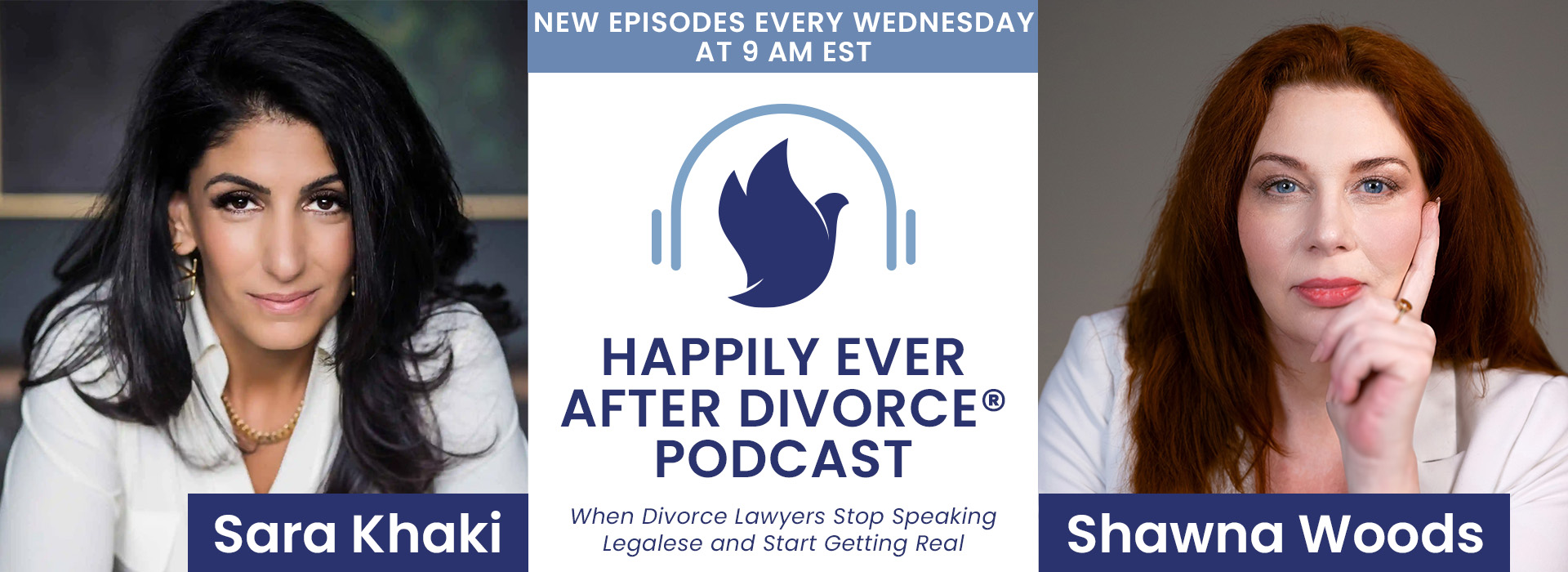
This is Sara Khaki and Shawna Woods from Atlanta Divorce Law Group. And this is the Happily Ever After Divorce Podcast. Welcome to the Happily Ever After Divorce Podcast. This is Sara Khaki with Atlanta Divorce Law Group, and I’m joined by our very own managing partner, Shawna Woods. And today’s topic is a fun one because I always love when we talk about how you can be a better partner in your marriage.
SPEAKERS
Sara, Shawna
sSara (00:05)
This is Sara Khaki and Shawna Woods from Atlanta Divorce Law Group. And this is the Happily Ever After Divorce Podcast. Welcome to the Happily Ever After Divorce Podcast. This is Sara Khaki with Atlanta Divorce Law Group, and I’m joined by our very own managing partner, Shawna Woods. And today’s topic is a fun one because I always love when we talk about how you can be a better partner in your marriage.
In your relationship or even in your friendships, the things that are within your control. Those are always awesome to discuss because a lot of our listeners are super responsible people who like to take their life under their own hands and make it better as much as they possibly can. They are always open for self-responsibility. So think this one of those episodes where we’re giving hopefully some thought-provoking conversation about
How can you show up better to get better results in your life? And this came to mind to me, it’s come to mind a few times. I have some very close friends and family members who are single women and are very much looking forward, having a incredible, fulfilling partnership with somebody in their life that they can love and grow old with.
And one of the common things I’ve always heard is them telling me what they’re looking for in the other person. So they’ll use words like, I just want to be in a relationship where I’m cherished. I just want to be with somebody that I can trust. I just want to be in a relationship where this person would take care of me. And I think those are all.
Just find qualities to look for somebody. ViShawna, the reason I’m bringing this up is because I’ve heard this a few times in some personal development work I’ve done myself and also some just coaching work I’ve done in my marriage and just thoughts I’ve had that were what’s worked in my own marriage and what hasn’t is at the end of the day, we are, I believe, a…
Reflection, a mere reflection of everything we’re receiving in our lives. So the advice I have is the things you’re looking for in your partner. Can you ask yourself honestly and say, am I those things as well? Am I a person who would cherish my partner? Am I a person that my partner can truly trust? Am I a person who wishes to also take care of my partner? Maybe that doesn’t mean financially that maybe that means
In your own love language of wanting to take care of that partner. So I want to propose this conversation with AShawna of how as a fellow person and family law and in relationships, what do you think about this concept of the things that we wish to see in our partner? We first ask for ourselves to become those things.
So instead of saying, want a partner who will cherish me. What if I was to say, I wish to find a partner that I can fully cherish. Do you think that would get you different results?
sShawna (03:35)
I think the way you’re phrasing it is very important because there, when I think about the concept of first you said, want somebody, you should be mirroring, right? What you expect to receive. And I think that’s a big statement. But I also think you have to break it down because what I think you’re talking about is shared values. You know, I have the value of needing to be cherished. I have a value of needing to be protected. How that shows up for me in a relationship
To another person may be different how it shows up from them to me. But the underlying core, the underlying core is the shared value. So in that respect, I agree with you. In another respect, I disagree with you.
sSara (04:21)
Go for it, I love this.
sShawna (04:24)
Because what we have seen in some studies is that, and these are studies that have been around, you know, these dating apps. Now some are just hookup apps, but some are really people are trying to matchmake who are out there actively looking for their mate, right? And I forget which one. There’s one that primarily the study was done on because it goes through all these likes and dislikes and who you are.
And what you do, and then they try to match you with this person who’s the most quote unquote similar to you. What some studies are showing is that we don’t actually have the most successful relationships who are similar in traits to us. We need somebody who complements our traits rather than is identical to our traits, right?
If you have somebody and I’ll just use Sara and I in our business relationship as an example. Sara and I are extremely similar. We have great ideas and we are very passionate about these ideas and we’re very passionate about culture and building these big ideas. But we also need those people in our office who are not the big idea people who are the
sSara (05:44)
We don’t need more Sara’s and Shawna’s in there.
sShawna (05:46)
We don’t, we’ve got enough. But what we need are the people who build that, right? And so any kind of really good symbiotic relationship to me needs the person who’s gonna compliment you, not necessarily mirror you.
sSara (06:06)
So would you say from what I’m taking from what you’re saying is, and I think it’s such a great way to sort of challenge what I’m saying and finding the distinction in traits versus values. So you’re proposing that in your partnership, having not necessarily the same traits, but traits that are complementary to each other is what makes it work better. But then the values, that’s where the mirroring needs to happen.
sShawna (06:35)
Yes, exactly. And I do think that’s the core of any good any good friendship, any good relationship is that you start with the value and you set a value, right? When you started talking about this, I want to feel cherished. That’s a value. I need to feel for me, I like protective, right? That’s that’s a value that I have. And I’m a very protective person.
sSara (06:57)
You’re
A very protective person. Yes.
sShawna (07:00)
Those traits may show up in different ways for both me or someone who I choose to be with, but my value, my underlying core value is protectiveness, right? And if it showed up in the same way, we may clash. We may have huge arguments if one of us is trying to take lead in that protectiveness and the other one isn’t able to say, I’m going to allow you, right?
sSara (07:29)
Going
To be able to receive your protectiveness. And so this is where I guess the conversation really comes to a head is the receiving part because I think that being able to match the values takes a level of vulnerability because for me to be able to be seen as somebody who wants to be in a relationship where I’m cherished, which means that I also want to be in a relationship with somebody that
I can cherish, I have to almost have a level of vulnerability and transparency that that is my value. That’s who I am. But I think that a lot of us this day and age, a lot of people, especially I’m just thinking of, I don’t have any statistics. I don’t know studies. I’m just going with what I’m seeing in our office with clients we speak to who we believe their marriage still has a chance and still has hope, right? So we send them the therapy, trying to get them to work on it because this isn’t
This is a problem that can be worked out. I really believe it is. This doesn’t necessarily need to lead to divorce. So many people come to these marriages and these relationships and these partnerships having the give and take flipped, right? They want to get the protection before they give the protection. They want to get, I’m cherished before they give that I’m going to cherish you. And being able to, I say this to my kids all the time. I said, when you go to Target,
I’m going to use a childlike example because I have children. You want to get a Barbie. Do you get to just walk out the store with the Barbie?” She’s like, well, no. I was like, what do you have to do? I have to go to the cash register and pay for it. That’s right. You got to give something in order to receive what it is you want to get. It’s the same thing, I believe, in how you present your values in a relationship. Have to put your value out. You have to give it.
In order to receive it. Instead, what so many of us do, we’re so protective and careful over our ego and so scared and maybe we’ve been burnt in the past, which so it makes sense. Or maybe we have some childhood trauma that puts us in a more, makes us nervous to be vulnerable with what are my values? What is it that I want out of this? And what can I receive from this? Is I may want, for instance, honesty and integrity
In a mayor in a relationship, that’s my core value. But because I’m so nervous and vulnerable with honesty and full integrity, instead I’m putting out mixed signals of who I really am, what the real truth about me is, what my real desires are. And that mixed signal mirrors back to me somebody that I may not be able to trust because they’re also, I’m putting up their radars that this is not a trustworthy person that you’re working with because
They’re giving you mixed signals. Now I, that’s when I think the mirror analogy works, right? Because I’m putting out something that’s not authentically me and I get in return something that is not authentic that of that person. And I don’t get what my needs met because I was scared to be vulnerable with the giving in the receiving.
sShawna (10:44)
Or you’re very unclear about what your needs are or what your values are. And I think that was really important what you said. First, we have to determine what our values are, right? We can’t just say, want someone who’s protective without really understanding what that value means to you and what it may mean to someone else. So when you’re talking about mirroring, and I just use very simple examples. For instance, if you are looking for somebody who is in great physical shape,
Are you going to also be in great physical shape? If that’s not important to you and you’re looking for somebody whose core value happens to be a religion, are you practicing your religion? So it really goes back to, first of all, I have to identify what my core values are, right? Pick five, just start with five and say, here are the core values that I believe in. And here’s how I practice my core values. Because to your point, if you just say,
Kindness, right is a core value of mine, but you are not actively practicing kindness How are you going to attract kindness? You’re not if you are actively saying I want kindness Because you want people to be more kind to you, but you’re not giving it back that person’s not attracted to you and I don’t mean in a physical sense. They are not attracted to your soul at that point so determine what your
Like I said, pick five. Your five core values are. And then start developing those so that the person who you’re mirroring and core values is also going to be attracted to you.
sSara (12:27)
I think this is actually excellent work, Shawna, to also for couples to do in therapy that are trying to recover from having serious communication issues.
sShawna (12:36)
Absolutely. And don’t get, I think a lot of people do get traits and values mixed up. Right. And we all have little traits that, you know, happen. I don’t like to get up early. That is not a trait that I’m going to enjoy experiencing. So I’m probably not going to like that in a partner either. Right. But what would be a complimentary, you know, trait is something, think about those things, right?
If for instance, you love home cooked meals, but you don’t particularly like cooking, that might be a trait that someone else has. The core value underneath cooking a home cooked meal for somebody is caring. Right? Showing you care for that person. You enjoy this, let me do this for you. Right? So tying those two in and just understanding that
Don’t look at your traits. Don’t look at the superficial part of what am I looking for in a partner? And we all start there when we were young. It has to be this tall, has to have certain amount of this hair, this eye color, this kind of smile. We all have these things that we think are important to us, which really aren’t. But the traits, do they compliment you? Or is it going to add, do be a subtract value?
sSara (14:03)
I also think it helps you present it to your partner better. Mean, one of the common things I hear from our clients when they’re going through this process and we’re trying to figure out is there a way for the marriage to be salvaged is, you know, I like to go out. I like to have friends. I like to socialize and she doesn’t, she’s a homebody. She never does anything. So this is a trait. Somebody’s super social. Another person isn’t typically.
These two types of traits really attract each other. They’re because I think it goes back to the complimentary traits that you were talking about. If you come at your partner after 10 years of marriage and say, you know what, I’m just bored with you wanting to be home all the time and I want you to go out or you go at them and say, you’re out all the time. You never want to be at home, spend time with me. And I think if you come in at it from a trait perspective,
You’re attacking them and they’re not going to hear you. But to Shawna’s point, if you come at it from a value perspective, which is I really value feeling connected to a community. I really value finding like-minded people and having conversations that broadens my perspective, right? Versus, you’re just not social and I’m really social. And then I think that can be heard by your introvert spouse.
Or partner to say, you know what? I may not be as comfortable as you are in a social setting, but I think I actually really value being connected to, being feeling connected to outside of just my home. I think that’s a very common trait that a lot of people have in common and it may bring the two partners back to that initial place where they fell in love.
And decided to start the partnership because there must have been some kind of a joint value. Hopefully there was some kind of a joint value that brought these two people with different traits together.
sShawna (16:02)
I agree with you. And I do think that it’s really important to understand the difference between what we were just saying the trait and the value are. Because when I was thinking about what you’re saying, honestly, I automatically went extrovert, introvert and thinking, well, that’s a value. How do you recharge as a value? But you’re right. It’s more of a trait. What is the value? I enjoy being connected to people.
sSara (16:27)
Right.
sShawna (16:29)
But what if your value is, enjoy being connected to my spouse and I’m willing to compromise on some of these, what we would say, superficial things? Like how many nights a week do we go out? How many people do we have over to the house? What is the comfort level for both of them and can we meet in the middle? Because if our value is want have community, right? We need connection.
sSara (16:52)
Connection.
sShawna (16:57)
Which is important for everybody in health and happiness. What is the level of it? And can we agree and meeting somewhere in the middle because we’re never going to find that perfect person, right? That doesn’t exist. When we talk about mirroring, we wouldn’t necessarily create the exact copy of you, right? So you’re not going to find that perfect person. You’re going to find that perfect person for this time.
In this relationship and it’s really up to us whether we want to make it work because we do have the core values or whether we’re ready to say, know what, our core values never coincide anymore.
sSara (17:39)
Absolutely. I’m going to finish this off with what I wanted to share with a little prayer that I came up with for my daughter, Hannah. She was going through a hard time a few weeks ago and she came to me, she’s like, you know, nobody understands me and nobody really tries to understand me. We’ve had this podcast episode before about, you know, working to be understood. I mean, the list went on of all the things that nobody’s
Doing for her. And so I said, you know, Hannah, um, are you those things for other people? Are you, are you working to understand other people? And she was like, I don’t know. And I was like, well, listen, you need to, instead of going around and praying that you’re going to find people that understand you or friends that are always kind to you or people who are looking out for you, why don’t you become all those things? So every night before you go to sleep and she’s doing this now,
When you just say a prayer of, you know, whatever you believe in, it works because a prayer is a prayer regardless of what your spiritual practice is. But, you know, she prays to God and she’ll say, God, please, please help me be a kinder sister. God, please help me being a friend that understands my friends. God, please help me talk to strangers who may need, that feel isolated.
And I thought about that, I was like, man, this could be so helpful to so many of our clients who are just going through such a hard time and all the focus has always been on everything they’re lacking in their life. And maybe part of the personal development, part of the gift of every pain they’re going through is developing themselves more into encompassing the values that they would like to receive more of in their own life. All right, that’s it. Thanks, Shawna.
sShawna (19:34)
Thank you, Sara.
sSara (19:36)
Thanks for listening to the Happily Ever After Divorce Podcast. If you’d to learn more, go to atlantadivorcelawgroup.com/resources
Discuss Your Options With Our Atlanta Divorce And Family Lawyers
Our experienced Atlanta, Georgia divorce and family lawyers understand that divorce may be a complicated, emotional time for you. Many important decisions need to be made that consider your current situation as well as your future.
An attorney can work to help you emerge from your divorce in a better financial, legal, and personal situation than you may have imagined. Call today to schedule a consultation.
Let’s Get in Touch.
Subscribe to Our Newsletter
Learn the latest on divorce & child custody
Subscribe to Our Newsletter
Learn the latest on divorce & child custody
 January 28, 2026