Empowered people make informed decisions that lead to living a life without regret. This is Sara Khaki and Shawna Woods from Atlanta Divorce Law Group. And this is the Happily Ever After Divorce Podcast.
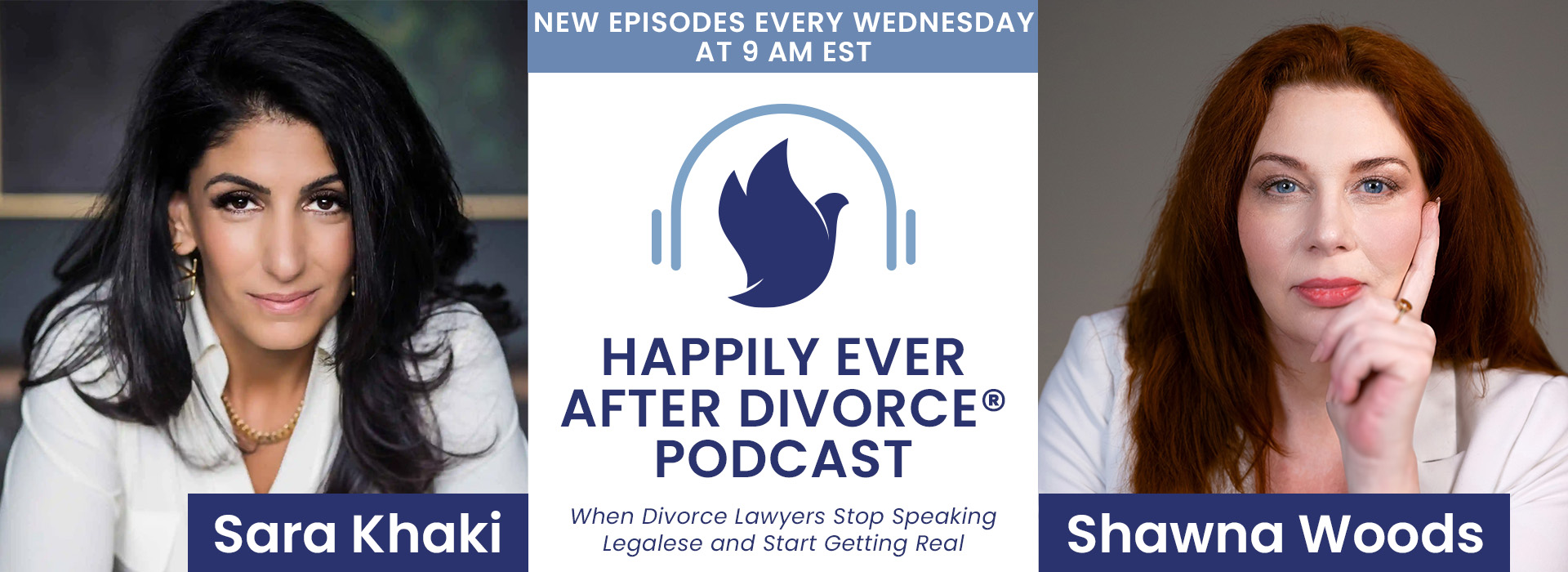
Welcome to the Happily Ever After Divorce Podcast. I’m attorney Sara Khaki with Atlanta Divorce Law Group, and I’m joined by our very own managing partner, Shawna Woods.
SPEAKERS
Sara, Shawna
sSara (00:05)
Empowered people make informed decisions that lead to living a life without regret. This is Sara Khaki and Shawna Woods from Atlanta Divorce Law Group. And this is the Happily Ever After Divorce Podcast.
Welcome to the Happily Ever After Divorce Podcast. I’m attorney Sara Khaki with Atlanta Divorce Law Group, and I’m joined by our very own managing partner, Shawna Woods. And today we will be discussing passive aggressive behavior. Shawna, think that anybody that studies human behavior, whether it’s their degree or they do it for fun, like you and I probably do, or, you know, come to an age where you’re trying to understand yourself, your partner, people around you better.
This is a term you’ve definitely come across, which is passive aggressiveness. And for the most part, this is not a compliment. If somebody’s being passive aggressive, this is not a compliment. It is a way of saying that you are being negative in a way, right? I wouldn’t want to be called passive aggressive.
sShawna (01:03)
No, and I think that the terminology of passive aggressive is expressing negative emotions or negative feelings in indirect way. So not coming out and saying, I don’t like what you just did, but doing something that the person who’s being passive aggressive somehow thinks they’re going to show the other person the error of their ways by not directly answering the question or directly saying, I don’t like what you did.
sSara (01:12)
In an indirect way.
sShawna (01:32)
But in acting in a different way.
sSara (01:35)
And passive aggressive, it’s a, what I think about it though is that there are ways that everybody, if they’re honest with themselves, have shown passive aggressive behavior. It’s similar to when we talk about, you know, narcissist qualities. There’s a bit of a narcissist quality probably in every human being.
But the degree that you’re diagnosed as a narcissist, that’s a whole different thing, right? But passive aggressiveness, it is a toxic trait. And the reason it’s toxic is because it’s never clear in the communication on where are the boundaries? What are the lines? What are the expectations? What are you asking for? What do you need? And what are you available to provide? It is so, again, in the gray, we talk about playing in the gray, it’s so in the gray.
Nobody knows where they stand. And it kind of creates this environment where the blurred lines sets people up for failure in their relationship, on the marriage or in the friendship. So being, getting prepared for this conversation, I looked at like a list of behaviors of passive aggressive nature. And it’s funny because when you look at this list, there are some where you’re like, Ooh, that’s bad. And then there’s some where you’re like, man, I’ve done that. Right. So I think it’s a nice.
Opportunity to bring some self-awareness and looking at your, I look at our own behavior and saying, where am I showing up passive aggressive? So silent treatment is a way of being passive aggressive, playing the victim card. As soon as somebody says something you don’t like, instead of addressing that somehow make taking it personal and, or wanting people to feel sorry for you to avoid the topic, denying anything being wrong.
This one really does frustrate me when somebody is upset and it’s clear, they’re making it clear that they’re upset. And when other people are asking them, nothing, nothing, everything’s fine. Nope, nope, everything’s fine. And I can understand that there will be moments that somebody needs to do that, but it is a frustrating one to be the recipient of for sure. Withdrawing, disconnecting, and you can, maybe that’s not so much in a silent treatment, but it’s just the energy.
The way your presence, you’re shifting and nobody knows what’s going on. Manipulation, instead of again, directly asking for what it is you need, manipulating other people into providing it for you. Withholding information where you’re not being concise and clear. You’re only giving pieces of the truth or messing with the truth a bit just to avoid the confrontation or direct communication. This one is interesting. I think.
Everybody must be guilty of this at some point. Would be surprised if somebody said they’ve never done this. Using contact through technology to avoid confrontation. How many times has it been where instead of picking up the phone and calling somebody and having that conversation directly, you’re like, you know what? I’m going to do this through text message, or I’m going to do this through email in order to avoid that face to face direct communication.
And we’ll kind of go through the goods and bads here. And then this one’s also, this one drives me crazy too, which is shaming. And I’ve actually tried to correct this in my children. For instance, Rami will say something to Hannah, like make fun of her for something. Like Hannah will say something like, don’t know, like what’s the capital of Georgia? And then we’ll say, it’s Atlanta. And then Rami will say something like, oh my gosh, Hannah, you didn’t know that? How did you not know that? And then she’ll be like,
I mean, don’t make fun of me. I’m just kidding with you. You’re too sensitive or you don’t have a sense of humor. That’s passive aggressive because you instead of just confronting the fact that you did something hurtful or you were making a mean joke, you’re shaming the person by breaking down their self-esteem and saying you’re too sensitive or you don’t have a sense of humor. And I think that one’s an interesting one because it’s not always clear, but people do that.
sShawna (05:45)
Absolutely,
People do that. Think the most experience I have with passive aggressive is actually kind of that tone. I know we’ve talked about how we grew up in different ways. When I was growing up, women were not allowed to be aggressive in the cult religion that I was in. They didn’t have leadership roles. They weren’t allowed to voice their frustrations to men. So there was a lot of passive aggressiveness in it.
You know, my childhood and I saw it on a daily basis. And it drove me crazy. Cause I’m definitely that type of person who’s like, just say it, just get it over with, just do it. But you’re right. We all do at some point engage in a passive aggressive behavior because we’re avoiding something. Right. And it’s that avoidance that is causing us the most discomfort. I really do believe when we’re saying something like, I was just, you’re just too
sSara (06:20)
Right.
sShawna (06:42)
You’re too sensitive. You’re too mean. You’re belittling the other person.
sSara (06:47)
Well, it’s the direct communication would be I am sorry that wasn’t taken well. Instead of saying that it’s right. You’re too sensitive. You don’t have a good sense.
sShawna (06:58)
Right. I’m sorry you took it that way. Right. Right. Putting the blame back on the other person and saying, you know, that was a really kind of unkind thing for me to say. I’m sorry I said that. Right. I mean, unpacking kind of where this passive aggressive comes from, I think part of it is cultural. I think a lot of women, especially back 20, 30 years ago, they were taught that was the only way to…
Change may change, right? Right. The manipulation that kind of they weren’t allowed to be on the forefront saying this needs to be changed. This needs to be changed. So do you think
sSara (07:33)
We see it more in women than in men.
sShawna (07:36)
I hate making those gender definitions that way, but in my experience.
sSara (07:43)
I I definitely think that the masculine, whether masculine energy is showing up in a masculine characteristics showing up in a woman or a man, the masculine is more literal. And the feminine is a lot more sharing of a lot of different kinds of information and bundling it up and using symbolism and not being as direct.
sShawna (08:07)
I think about passive aggressiveness. You watched Harry Potter. Yes. Umbridge, know, Professor Umbridge where she comes in and you know, she’s the nice one, right? She dresses pretty and everything’s nice. And that’s how I look at passive aggressiveness. Everything’s nice on the surface. But if you scratch down even one layer, it’s filth, it’s dirt, it’s, you know, anger and all of these ugly emotions that come out. So anytime I think about passive aggressive,
I’m getting that face for me. What face do you see?
sSara (08:41)
So yeah, I get the face of in my culture, Middle Eastern culture, specifically the Iranian culture, probably even more so than the rest of the Middle East. This is very common. And the reason is we have a very sense of formality with how you treat guests and how you treat family. There’s a lot of expectations on how you behave in our community or with the family. So for instance,
If somebody shows up at your door, family member shows up at the door, whether you have food at the house or not, it would be rude to not invite them in and try to feed them. If you are going out to dinner, whether you have the money in your bank account or not, it would be rude to not offer to pay for the whole bill. If you’re wearing your grandmother’s favorite scarf that she gave you right before she passed away and somebody compliments it, it would almost be rude if you did not offer to take it off your head and offer it to them.
So let me set that up for you. It’s very generous, very hospitable. That’s all the positives. The negatives is it leaves a lot of direct communication to be desired. Instead of saying, I don’t have enough food at the house to invite you in, you would come up with some other completely crazy excuse of like,
My gosh, like I have worked so hard. My house is such a mess. I’m exhausted. The kids are sick. Everybody’s sick. But if you guys want to come in, come in. That is passive aggressive. Right? Like feel sorry for me. Feel sorry for me. Feel sorry for me. But would you like to come in when you don’t really mean it? That’s what comes up for me. It comes a lot of like moments of confusion from my culture, moments of mom, is this okay to be direct about? Is it okay to…
Looking at my parents to kind of get the cues. That’s sort of what I think about. I think of a very state of confusion. I don’t really have a face to it, but I have a state of confusion where everybody’s just dancing around with a lot of language, with a lot of words, and nobody’s just saying it in a couple of sentences. But I also have compassion for it, right? Because I do think that there is a way to say that somebody is a passive aggressive person versus
This is not a aggressive person, but something’s showing up in a moment has showed up in their life that triggers maybe something from their childhood that does not make it make it safe to confront. Right. So they’re turning to passive aggressive to feel safe. If your parents never let you feel that it’s safe to confront, if it wasn’t safe to confront in your household, if direct communication was not safe in your household.
Or if you had a parent that took up so much room, right? And was so loud with their emotions and took up so much space with their thoughts about everything and their direct communication. Did they possibly leave room for other people to also be that direct or was every did everybody, especially the children, learn to tiptoe around that person’s personality? And as they grow up, they when they’re in an environment or somebody
Triggers them as a very loud in your face kind of a person. They’re like, okay, it brings them back to their childhood trauma and I’m not safe here. I got to turn to what I learned my survival skill as a child. So I can have compassion for when somebody has those moments where they turn to passive aggressive to feel safe. But I don’t know if I can be around somebody that is their nature is manipulation, withdrawing.
Not telling the full truth if that’s just constant default of just who they are.
sShawna (12:37)
No, I completely agree with you of is this a personality trait or is this something you’ve engaged in? Because we’ve all engaged in at some point in time. Sarcasm is another example of passive aggressive behavior. I can be sarcastic at times and I notice that in myself and I do try to check myself on it. But I do think that there are times when it’s an automatic.
Big that comes out because you’re right, something from childhood, something traumatic that’s happened in past. Sometimes it really wasn’t safe for people to directly address a situation so there were different things that were done. And again, I’m not saying all women were passive aggressive, but I’m thinking about this story, and it’s a true story, but it’s these women in Italy. We’re talking about like the 1600s, 1700s.
And the men were abusive in this village, right? They would openly beat their spouses. And so all of sudden, men started dying of different illnesses. And of course, it comes and turns out that these women were killing them, right? They were poisoning them with different things. It would be the soap. Would be in their pies. Anytime they would figure out, we think it’s this, then the women would move it to something else, right?
Passive aggressive well aggressive for sure, but that is an example of an extreme passive aggressive That was born out of a necessity for that period in time and I’m saying murderous good guys Definitely definitely not saying that but it came out of a necessity, right? So I do think that when we think about you’re right We can have compassion for somebody who’s passive aggressive because it came out of a necessity
sSara (14:15)
She’s definitely not.
sShawna (14:28)
Can you grow beyond it is the question and should you?
sSara (14:33)
So one of the big things I’ve learned from Alison Armstrong is animal instinct versus human spirit. Our animal instinct is that first fight or flight kind of reaction of, I safe? Am I okay? Or, you know, do I have enough to provide kind of a gut reaction as we are maturing as humans and adults, and we want to be better and show up better for ourselves and our loved ones.
We want human spirit to overcome animal instincts. And I think if we’re all aware that we have, there are moments in time where we don’t want to, you know, we don’t want to go at something head on, direct directly and tackle it. It’s probably a good time to check yourself and say, why is it? Why do I, why am I not facing this head on? And why is my initial instinct to
Want to send a text message instead or with tell everybody I’m okay when I’m not or withhold information or disconnect or not give everybody the silent treatment. Right. And if you can trace that back and you’re like, okay, this actually doesn’t serve me. Everybody around me and myself included is better off by me directly handling this. Then that’s a sort of like human spirit thriving in that moment over just having animal instincts. I do think though,
That there are moments in time where you have to assess the situation. Like not every relationship in your life needs to have that moment where you just go head on direct and say, yes or no. Some things in life could just be some relationships in life might be at a point where you just need to say through a text message, no, and I’m not available for that. No, that will not work for me. Or you know what?
I am going to need some time and space from this situation and I don’t need to right now spill my guts about how I feel. And as long as you’re doing that, not from a place of animal instinct, jerk reaction, I need to be safe or I want to make the other person know that I don’t agree or that I don’t, that I want to oppose them, right? But in an indirect way, it’s not coming from that place and you just need.
To give yourself some time and space, I think that’s perfectly fine, but you just need to be clear on where it’s coming from.
sShawna (17:00)
I agree and I think that one of the biggest problems that come from having someone who is passive aggressive is the manipulation that you touched on. Especially either in a tight family unit or a small office space. I may not have even known I’ve offended somebody and all of sudden because they can’t say, that offended me, now we’ve got this issue. I don’t even know what the issue is. All I know is this person is acting up.
They’re doing different things, what’s going on. So now you’ve placed the burden on somebody else to go figure out what’s wrong with you, where they don’t even know that that was a problem to begin with. And it is such a childish gut reaction, you’re right. It is an animal kind of instinct. It’s our first reaction. But I do think what you said about having compassion for people like that is very important.
And sometimes it takes someone who has done that work to sit down with the other person and say, so I’m noticing this behavior. I don’t like this behavior. Can we find out what’s going on? The person who’s acting passive aggressively may not even understand themselves what the issue is. But sitting down with them and unpacking it is extremely important and just say,
sSara (18:04)
Right.
sShawna (18:22)
I don’t tolerate this kind of behavior in whatever relationship. So we either have to fix it or we have to let this go.
sSara (18:30)
Right, right. You know, I think that the way the extent of the compassion for for passive aggressive behavior is the point at which the person’s is no longer just withholding the fact that they’re hurt from something, but now enrolling other people into it. Right. And in indirect ways, constantly wanting you to know.
Yes. Right. Whereas whether it’s just like they’re still in your space, but they’re rolling their eyes or they’re being short with you about other things that are not even related or not being able to even engage with them in any normal way without them just having a very heavy energy around you. And the worst of it really being with bringing other people into the scene. That’s where my compassion for it really ends. But I can understand that.
You know, the need, the human need for connection. And this is why perhaps it shows up more in the feminine characteristics, more in the masculine, because the feminine characteristic of need for connection is a very, very high one, right? The masculine is the need to provide. Safety for the masculine is providing, safety for the feminine is connection. And if you are in fear of losing connection by having direct
Communication, I can have, I can have compassion for the fact that you would withhold information. You would say everything’s okay when it’s not, because it goes back to the episode we did about, are you somebody safe to be honest with? Yeah. Right. I also think to myself when I’ve had interactions with people who’ve consistently giving me, given me passive aggressive behavior, and I’ve actually done a check on myself on what am I inviting?
Why is this person consistently giving me passive aggressive? Am I also being passive aggressive? And now we’re just two people passive aggressive, like tiptoeing around this like little fire dance, or am I not safe to tell the truth to? Is that what’s happening here? So I do a quick check on myself as well, or have I not set the right boundaries in this relationship? Like you said, like, hey, this behavior keeps showing up. And I’ll tell you, dear relationship of mine where
I was constantly getting that and had that check with myself where I was like, okay, all communication is through texts. All communication is indirect. All communication cannot, no communication is happening in any short text messages. They’re all really long and not a lot of fluff around the bottom line. These are like signs I can give you from my personal experience. And when I had enough of it and I decided to have a confrontation about it, just the way you described, Hey,
I feel like we can’t have any direct communication. I feel like everything we say could lead to like misunderstanding. This person cut off the relationship. And that’s how I knew. You know, it’s very clear sign to me of like, okay, like what you thought you had, you never had.
sShawna (21:33)
Bye.
Yeah, I’ve had similar experiences where I had to cut off relationships like that as well. This is kind of an oddball experience where somebody was posting about me on social media, knowing that I would see it.
sSara (21:58)
That is so passive aggressive.
sShawna (22:00)
And obviously they’re not calling me out by name, but it’s so obvious to me that that’s who they were talking about. Reached out to him immediately. I’m sorry if I’ve offended you, but this is not the way I handle things, you know, trying to, oh yeah, yeah, yeah, and they’ll never do it again. And then, you know, a of weeks later there it goes again. And I just had to completely distance myself from this person in my life because those kinds of things where they’re damaging you instead of addressing whatever issue they have with you.
Is it something you want? Is it something you can tolerate? And I love what you said. How am I inviting this? Right. If you allow that to happen, if you allow somebody to, other people are to see how you allow other people to treat you. And if you don’t stop it, okay, that’s how we treat Shawna. That’s how we treat Sara.
sSara (22:49)
Well, I think it’s the way you can check to see that. I the passive aggressive toxic person in the relationship or not? And if I, if I put a stop to that and the other person is willing to elevate the relationship to a higher level of communication, then great. Now I know I definitely played a massive part in this. Right. And, if they are like, no, I’m actually not available for the relationship where we’re more direct and we’re more honest and
This isn’t the pattern of behavior, then again, the relationship you thought you had, you probably never did. That’s painful, but I think it serves everybody better to disengage. Thank you, Shawna. Thank you. Thanks for listening to the Happily Ever After Divorce Podcast. If you’d to learn more, go to atlantadivorcelawgroup.com/resources.
sShawna (23:28)
Absolutely.
Discuss Your Options With Our Atlanta Divorce And Family Lawyers
Our experienced Atlanta, Georgia divorce and family lawyers understand that divorce may be a complicated, emotional time for you. Many important decisions need to be made that consider your current situation as well as your future.
An attorney can work to help you emerge from your divorce in a better financial, legal, and personal situation than you may have imagined. Call today to schedule a consultation.
Let’s Get in Touch.
Subscribe to Our Newsletter
Learn the latest on divorce & child custody
Subscribe to Our Newsletter
Learn the latest on divorce & child custody
 January 28, 2026