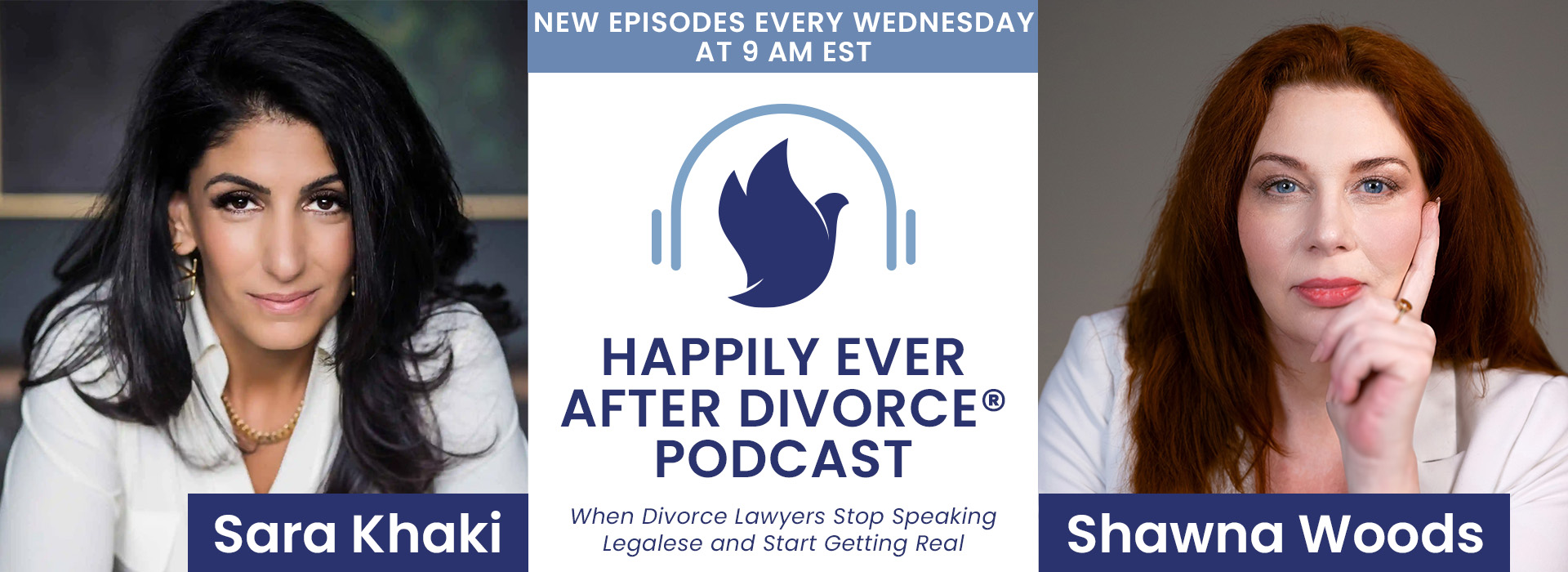
Empowered people make informed decisions that lead to living a life without regret. This is Sara Khaki and Shawna Woods from Atlanta Divorce Law Group. And this is the Happily Ever After Divorce Podcast. Welcome to another episode of the Happily Ever After Divorce Podcast.
SPEAKERS
Sara, Shawna
s Sara 00:00
I’m Sara Khaki with Atlanta Divorce Law Group, joined by our managing partner Shawna Woods. Shawna, welcome. Hi, today we’re going to talk about telling the truth and that it might not always be as straightforward as just opening up your mouth and spitting it all out. And that even Telling the truth requires some responsibilities and boundaries, some respect. Shawna, talk about the concept of, that we both have studied in various books about culture, about team, about leadership, about partnership, the idea of telling the truth.
Because it’s just what you do versus telling the truth because it’s necessary and it’s the kind thing to do.
s Shawna 01:01
Well, if it was just telling the truth, because you do, you’d be no better than a two year old who points at everybody and says what they see. What’s going on there? Telling the truth really comes from, and especially a culture like ours in your office setting and in a setting when you’re dealing with professionalism, is it’s the reason you’re telling the truth. What is it the truth that you’re telling? Right? And you have to approach it as
s Shawna 01:29
Is this necessary for this person to know? Is this gonna help this person grow? If it’s not gonna help this person grow, is there something else that this person needs to know this truth? I might not need to know that I was walking around with toilet paper on my shoe all day unless you caught me before I did. The kindness is stopping that need.
The kindness of what is it behind, what is this driving force that I need to tell this person the truth?
s Sara 02:04
So, Brene Brown, which we’re both fans of, gives a very good step, questions on how to think through it before you just start rambling off the truth and bulldozing over people’s feelings or expectations. So, what are the formulas she gives us?
s Shawna 02:22
That is actually the truth is one of them. Is this true? Right. Is this kind? And is this necessary? And if it’s not all three, then you probably don’t need to say it.
s Sara 02:35
So let’s talk about the concept of kind versus nice. This is one that I love teaching my children. Yes. Yes, because they’re like, this isn’t very nice. And I’m like, I’m not here to be nice. I’m here to be kind. What does that difference mean to you?
s Shawna 02:48
To me, it means a person who’s nice, not necessarily telling you the truth. When I think about nice, I think about someone who does not want to rock the boat, who wants everything to look pretty on the outside, they don’t care how it looks on the inside. When I think about kind, I think about is this going to assist this person in some way, even if it’s kind of.
s Shawna 03:15
Hurtful at the time of hearing it, right? Is this going to help this person grow? Is this going to help the company grow? Right? I don’t have to make everything pretty for you. A lot of times kindness isn’t pretty. A lot of times it’s messy and it’s hard and it can be harsh if not said in the right way, right? You have to say it with empathy. Right. I don’t necessarily like niceness.
s Sara 03:45
Right. Well, I find niceness manipulative. Yes. I don’t trust nice. Yes. I think to me, nice is telling somebody what they want to hear, even if it’s not true, just so that they can like you, they can appreciate you and they can love you or do something you want them to do. Yeah. So I find nice to be manipulative and I usually instinctually pick it up and feel odd about somebody that is just like overly nice or overly
Flattering or complimenting like, what is this for, right? Kind, to me, is telling somebody what they need to hear, even if they don’t want to. So sometimes they may need to hear it and they want to hear it. That’s great. That’s a match. And that can come across as, you know, that was nice. That was kind. But some lot of times kind is not a match with what they want to hear. You’re giving them something they need to hear, but they don’t want to hear it. And I think it takes
s Sara 04:44
True love to give kind versus nice. Because wHen you’re giving kindness, you’re doing it for somebody’s growth, you’re doing it for somebody’s awareness, for somebody’s knowledge, and giving them a piece that could be difficult for you to even say, right? But at that moment, you’re deciding that this person may not like me because I’m not giving them niceness. And I might not get any love from this, I may not get any appreciation from this, and they may actually not like me, but I’m gonna love them enough.
To give them this truth that’s necessary for their growth, even though they may not want to hear it, and be okay with not being appreciated for it, being okay with not being loved and liked for it.
s Shawna 05:27
So what I’m hearing you saying is that kindness is about the other person. Yeah. Why niceness is about yourself.
s Sara 05:33
Absolutely. Niceness is taking something from somebody. Kindness is giving. And I trust that when somebody gives me some feedback that I’m like, man, nobody else would have told me that honestly. I see that to be kind. I shared with the firm a few days ago when I was looking for a job out of law school. Had on my resume, co-founder and president of the
s Shawna 05:38
Yes.
s Sara 06:02
A Muslim lost their association of Georgia law. And that point in my life, I associated with the Islamic religion. And this wonderful man called me, that was my mentor at the time. He was like, for the places that you’re looking for a job, I was looking for a job in Chattanooga, Tennessee, I would just, I think it’s a wonderful thing you have that there and you need to make a decision if you want to keep it or not. But some places here may actually overlook your because of it. That was a kind thing to do in my book.
s Shawna 06:27
President.
s Sara 06:31
A lot of other people would have thought, he made some sort of a racial comment or he said something out of school. To me, I experienced that as that must have been so hard for him to say, but he felt I needed to hear that and I needed to have that awareness. And it put me into that whole process, eyes wide open, uncomfortable, but eyes wide open.
s Shawna 06:54
And a lot of times when you’re being kind, it is that hard thing to say. It is that you have to think about this as they’re not going to like me maybe. They may take this the completely wrong way, but I feel the need because of the care I have for this person or the care I have for this organization that this person needs to hear this. Right. Right. And I guess that’s what I mean when I say niceness is I’m not going to rock the boat. Right. Let’s just be nice person.
s Sara 07:10
Because kind can definitely rock the boat
s Shawna 07:26
Kind blocks the boats a lot and sometimes the boats need to be rocked.
s Sara 07:30
For sure. That’s how change happens. Exactly. And then there’s the balance of, again, going back to our beautiful pendulum swing, the person who I’ve come across this character a lot and do not love it very much, the person that is the self-proclaimed asshole of the room. You know what? I’m sorry. I’m just so honest. I’m sorry. I’m just brutally honest. I know I’m such an asshole, but I’m so honest. I just have to speak my truth.
s Shawna 07:48
Right.
s Sara 08:00
And just because you told us you’re an asshole, doesn’t it make okay that you’re an asshole? Right? Just because you said, I’m sorry, before you were honest, doesn’t make it okay that you just gave information, nobody cared to hear it, doesn’t do anything for anybody. Or just because you said, I’m brutally honest, doesn’t make it okay that you’re being brutal with people. If you think about brutally honest, means it’s, that just tells me it’s unnecessary because it’s brutal. It went beyond what was needed.
s Shawna 08:07
Does it change?
Right.
It’s what are we trying to accomplish with our honesty? What are we trying to accomplish? For instance, the man who was trying to help you. And to your point, If I’m just the self declared asshole, the only thing I’m deriving from speaking the truth is pleasure for myself.
s Sara 08:37
I actually needed to hear that.
It’s pleasure for myself and it’s taking something that I cannot carry within and unloading on others. It’s, I cannot walk around and have enough maturity and responsibility to hold some things to myself without having to unload on others and make other people carry that baggage. Try to others, right? Because I’m the one that says what everybody else is thinking, but nobody else is saying.
s Shawna 09:12
Or try to control and manipulate.
s Sara 09:21
And that’s another, sometimes that’s helpful. The person who speaks up and says the thing everybody’s thinking and nobody’s saying that can create wonderful movements that can create wonderful change when it’s again, necessary, right? And true, right? Because again, if it’s not true, what’s the point? But you do need to check yourself in those moments. I think some people do it just for the sake of being special, where they want to be that voice in that room.
Just to get their special.
s Shawna 09:52
Yes, and I also think some people do it because they may not have had a voice previously. Maybe they were raised in a way where they weren’t allowed to voice what they saw as the truth. So you write the pendulum dot swing. Think with maturity, I think with leadership and with growth, when you check yourself, if you were that person out there saying, I’m the honest one, why? Yeah. Why are you the honest one? And really check yourself and say, is there growth that comes out of
Not just it felt good in the moment. Because a lot of things feel, you you want to say something and they feel good in the moment. We see a lot of this with social media warriors, And they pop off and they say something and all of a sudden you have this long back and forth on social media. It was completely unnecessary things that you’re not going to change anybody’s mind. You’re not going to have movement or understanding on either side.
s Sara 10:49
You just create a lot of noise in your life.
s Shawna 10:51
Just created a lot of noise and activity in your life. And I think that A lot of times when people are going through, you know, what they go through in our office with divorce, there is that need to be like, let me tell you my truth. Right. Let me tell you my version of the story. I don’t know where you see it the most detrimental, but where I see it the most detrimental is when people want to do this to their children.
s Sara 11:17
Yes, yes, let’s talk about that.
s Shawna 11:20
And had a podcast earlier about appropriate conversations to have with children, know, when they need to know what they need to know, right? And having them lead these conversations. One of the things that courts hate, and I personally just can’t stand, is when parents feel like they need to tell the children how bad that other parent was to them.
s Sara 11:44
Daddy cheated on me or your mommy was with another man all this information I’m just being honest
s Shawna 11:49
Right.
I’m just being honest, My children deserve to know the truth is one of the phrases that I hear that really goes all over me. Because to me, your children deserve to have two parents. And you’re robbing them of that because of your need to speak the truth to your children. And it’s not in my experience, when the children get older, they don’t appreciate that quote unquote honest parents.
s Sara 12:19
Now I’ve seen a lot of adults that have gone through therapy after years where they had really deeply sided with the parent that had given them all of the information and a lot of the truth quote unquote. And later on in their adult years, they have sat down and thought that through and realized, wow, I was manipulated. I was treated with, I was given a lot of information expecting me to grow up.
Really fast information that was not necessary for me to know. I felt that as a child, when I remember my grandmother, after my grandfather passed, we would go to Iran to visit my grandmother. And in her mourning of my grandfather, she started having like these thoughts about their first beginning of their marriage. And I was six years old and she would lay me in bed. These are bedtime stories she would tell me. She would tell me about love letters she would find that my grandfather had written another woman.
And I’m six years old and just lost my grandfather that I idolized, like idolized. And I didn’t know what to do with this. And to this day, I think back to that and really impacted me. I didn’t know what to do with this information she was sharing with me. And it was like, I’m not your friend. I’m not your therapist. I am your grandchild who loves you and thinks of you as the most amazing human being in the world. So anything you tell me is going to go straight to my heart. And this is my precious time with you as I’m visiting you.
And you’re dumping this on me. And it was her own emotional stuff she was dumping on me.
s Shawna 13:50
Yeah. And why dump it on a six-year-old? That’s the biggest question is because we feel we want this person on our side. We love them enough. We want them on our side. I really had to fight against that with the relationship that I had with my mother was very rocky, right? Very rough relationship. But I had my mom and a lot of that had to do with an undiagnosed at that time mental illness she had. Well, she had gotten diagnosed and she really could become a
Really good grandmother to my daughter, which was horrible for me, but it was great for my daughter, right? Because I so much wanted to be like, don’t like your grandma, she was awful to me. Right, how come I didn’t get this version of you? And, but fighting that, and I distinctly remember when my daughter did find out some other things, you know, as when she was older, and she asked me, she was like, why didn’t you ever tell me these things? I said, why would I?
s Sara 14:31
Yeah, or where was this when I was little?
s Shawna 14:49
Right? And that’s the question I think we have to ask yourself. Why are you talking
s Sara 14:53
Right. And it’s we had this conversation about parents with mental illness. Yeah. Same as When I was 14 and my father started sharing with me his his feelings about life and right in his depression. And it was like, I don’t know what to do with this. I don’t know what to do. I don’t know what to do for you. I don’t know what to do with this is more truth than I can handle.
s Shawna 15:13
And honestly, will tell you, don’t think it matters the age of your children because even if they’re adults, they may not be wanting to hear that side of it. Right? They still want to have those parents. My parents divorced each other twice. Once when I was five and once when I was grown. And I was very much involved in their divorce when I was grown. And I wish I wasn’t because I did see two sides that I didn’t really want to see. Right? I didn’t want to know all.
That stuff, even as an adult, right? You still want to be able to say and have and choose what you’re letting in about this other person. Right. I think that’s one of the key things that really we emphasize because I know it’s so hard when you’re going through this emotional process, right? It is so hard and you feel so wrong. And even when they want to say that person destroyed our family, it’s your fault. The kids don’t get a full family. Right.
You’ve got to hold that back. It’s so unkind.
s Sara 16:16
There are a few books that I think we need to bring to the forefront for more further study on this. One is anything by Brene Brown. She so much about this. One book that I personally love is a culture code, which talks about this idea of candor versus brutal honesty. And it teaches how candor is necessary true. Yes. That needs to be heard. And it’s not a lot of rambling. It’s to the point.
It doesn’t have excess information like brutal honesty or I’m just an asshole, I tell the truth, it does. It is to the point and it’s clear and it’s simple. And the other book is Candid Conversations. Those are all three really, really good books that I would recommend.
s Shawna 16:59
I think those sound great.
s Sara 17:00
Thanks, Shawna. Thank you. Thanks for listening to the Happily Ever After Divorce Podcast. If you’d to learn more, go to atlantadevorcelawgroup.com forward slash resources.
Discuss Your Options With Our Atlanta Divorce And Family Lawyers
Our experienced Atlanta, Georgia divorce and family lawyers understand that divorce may be a complicated, emotional time for you. Many important decisions need to be made that consider your current situation as well as your future.
An attorney can work to help you emerge from your divorce in a better financial, legal, and personal situation than you may have imagined. Call today to schedule a consultation.
Let’s Get in Touch.
Subscribe to Our Newsletter
Learn the latest on divorce & child custody
Subscribe to Our Newsletter
Learn the latest on divorce & child custody
 January 26, 2026