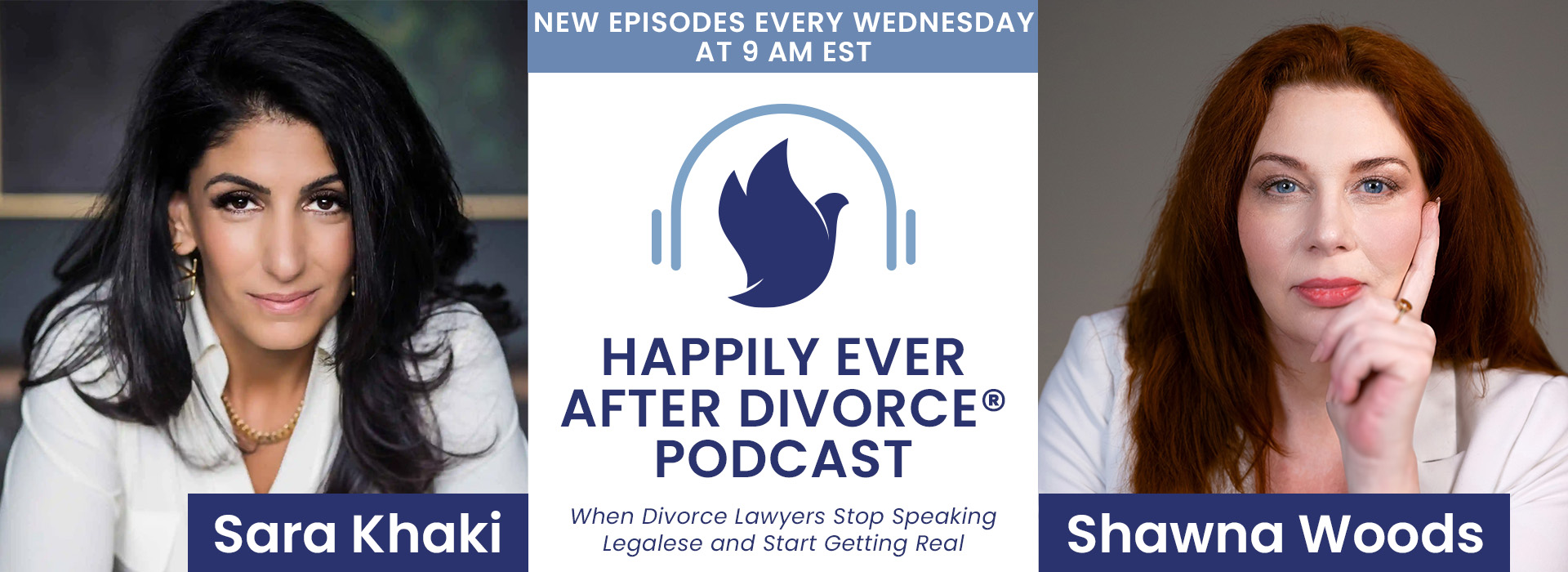
Empowered people make informed decisions that lead to living a life without regret. This is Sara Khaki and Shawna Woods from Atlanta Divorce Law Group. And this is the Happily Ever After Divorce Podcast. Welcome to another episode of the Happily Ever After Divorce Podcast
SPEAKERS
Sara, Shawna
sSara (00:00)
I’m Sara Khaki with the Atlanta Divorce Law Group and I’m joined by our managing partner Shawna Woods. Shawna, today we are going to talk about forgiveness.
So I’m sure we both have done the same thing coming into this. Don’t usually, Shawna and I don’t usually talk about what we’re gonna say on these podcasts, but each of us takes our own individual moment to kind of gather our thoughts. And I am willing to bet that we both looked up the definition of forgiveness or forget. Yeah, yeah, What did you find?
Wow, release. Yeah. That was a good one.
So does exoneration pretty much mean we move on as it never happened?
Definitely the clients that we are working with.
Right. And in the definition of forgiveness, there is nothing there that hints at there’s a forgetting involved. Yeah. You do not need to forget in order to forgive. Now, I’ll tell you this. I don’t know if this is just specific to me and Hisham. When Hisham forgives, he actually does forget. He has that ability. So he will not remember a negative experience, which is…
A beautiful gift that he has. I don’t know if this is a masculine thing versus a feminine thing. Whereas, I believe that for me, I’m more the feminine and we hold onto a satchel, don’t we? We have a little satchel of data points, of incidences, and I’ll forgive you, but this one went in the satchel.
Right, right. And it will impact your husband’s credit score with you. There’s only so many more late payments that I can forgive.
sShawna (04:16)
That actually happens quite a bit in our world, with our clients, is they wholeheartedly believe someone, right? And they may be being aligned to for an extended period of time about a very variety of things. And then they start judging themselves and questioning themselves about everything. You know, can I believe this person?
Thought I could, but can I because I wholeheartedly believed this person. So I absolutely agree with you that forgiving yourself and finding that cliche inner peace with your part, right? And I’m not saying anyone would, they’re not to blame, but your part in the fact that yes, you played a part in the lie in that you believed it.
sSara (04:55)
And I think it’s important for each of us to know and for us to relay this to our partner in life and to our closest people in our lives of this is what I need in order to forgive and
To give that to the person who is deeply wants to make things better in order to have that level of maturity to actually give them that of this is what I would need. Have you ever thought about what you need?
sShawna (05:12)
Exactly. That’s all. That’s all right. But now you doubt yourself. Now you feel like I should have been smarter. I should have been more astute. I should have been whatever it is. Insert the thing that you have the
Insecurity about here. And I absolutely agree that Until you forgive yourself, you’re not going to let go of that anger because with having that acceptance that you played a part into, comes to the shame. Yes. Right. That deep shame.
sSara (05:25)
In order to Okay.
sShawna (05:40)
And now you don’t want to tell anybody else about that lie, about the thing that you need to forgive because you’re owning shame that does not belong to you.
Absolutely. I cannot tell you how many times I’ve had to say to either the spouse, husband or wife, the court is not going to flog them in the middle of street. They are not going to declare your spouse was a jerk day. You’re not going to get the validation you think by telling your story in court. All you’re going to get is disappointment at the end of the day.
sSara (06:47)
That is very important for me as well when I’m receiving an apology. I need to hear from you specifically. What did you do wrong? I still carry some of the pain if I’m the one that has to tell you what you did wrong. And that’s not always fair. Sometimes people just don’t know, right? And
They just can tell that you’re upset about something and they come to you and you’re not able to be the same with them.
sShawna (07:10)
That they were not held to the accountability that you wish they would be because that’s not what divorce
Court is for necessarily. If there’s financial things too, we can have some, I wouldn’t say retribution, but reimbursement anyway. But the vast majority of time, even when we’re talking about adultery or verbal and mental abuse, which is very prevalent in divorces,
sSara (07:17)
It helps a lot for me if somebody can truly from their own words acknowledge and give me the validation of my feelings. And I think that’s a part that if you are in need of someone to apologize to you, you need somebody to help you understand and help you heal
From that. Of course, we all understand that it’s for us. Giving forgiveness first starts with doing it for ourselves.
sShawna (07:39)
It’s not going to be that satisfaction that you think you’re going to get from the court.
sSara (07:46)
But what can you do for yourself? How can you stand up for yourself and say, hey, when I need forgiveness from someone, I’m not just going to sit by and be upset and be mad and wait on it and hope that things will get better. Sometimes you may need to go and let this person know, hey, this really upset me. And here are the reasons that upset me. And here’s what I need you to do in order for this, for if you want my forgiveness. And it’s not so much even
sShawna (08:10)
Was it really good?
sSara (08:16)
Just doing it for that person to give that person the chance to apologize, it’s a big, big message to your own mind that when I need something, I stand up for myself and I go ask for it. It goes beyond just, you know, receiving apologies. It’s a big message to your own sense of self, to your own self-security that I don’t just wait by to be made whole again because somebody decided to take the moment and do that or didn’t.
But I’m actually will stand up for myself and will go ask to receive what it is I need to move on. There’s another big trick to forgiveness that I had to learn. Forgiveness actually starts with forgiving yourself. And I think this is the part that is hard for us to internalize because in every transaction we have with somebody.
Every incident we have with somebody, every experience we have with somebody, there’s always two parts to it. Doesn’t mean you didn’t get wrong. 100 % you got wrong. But You had some part in being wrong that you’re not forgiving yourself for. And it might have not really been your fault at all that this happened, especially when we’re talking about children. This is the hardest part of when children are wrong. They internalize it.
And they go on for life blaming themselves for it until therapy or know, the counseling helps them out of it. But even as adults, we’re having trouble with this is understanding that your spouse cheated on you. There is some core wound inside of you that is blaming it on you that you got cheated on. If somebody abused you, there is a core wound somewhere inside of you. I’m not worthy. I’m not good enough.
I am not worthy of love. I’m messed up in the head. Whatever core wound that is that you’re using to fuel the fact that you got hurt and you’re not able to forgive, truly forgive that person until you first forgive yourself. For me, there’s times when I’m having a hard time forgiving someone for something they’ve done and I find myself having a hard time forgiving them because
The way I showed up in that transaction or in that relationship and allowed this hurt to come about makes me actually have a trouble with my own judgment. And that becomes my core wound. Where I judge myself and I judge my judgment. Where I’m like, I actually trust my judgment that I let this happen? Until I can forgive myself for that, I have a hard time forgiving the person.
Your part might have been as simple as you believed him.
And you’re looking to make that shame go away through retribution in all other places that will never truly heal you. And in our practice area, family law, what is so heartbreaking is when you have a spouse that was wrong in the marriage somehow looking for the court to give them that retribution. The court will never sit down and say, ma’am were a wonderful wife, you did everything right.
And he did you wrong and you make sir or a bad man. And as simple as this sounds, emotionally, the child within is seeking that the child that still believes that life is fair. The child that is like teacher, teacher, he took my pencil, put him in detention, right? We’re still looking for.
And I think it would be interesting for a lot of us to think that even if we’re not in a divorce case and it’s just a family relationship, a friend, somebody out there that you feel hurt by, that you haven’t been able to forgive yourself for your part in that hurt, where are you seeking retribution for that? And how are you showing up because of that retribution that you’re seeking? I think that’s it.
Thanks for listening to the Happily Ever After Divorce Podcast. If you’d to learn more, go to atlantadivorcelawgroup.com/resources.
Discuss Your Options With Our Atlanta Divorce And Family Lawyers
Our experienced Atlanta, Georgia divorce and family lawyers understand that divorce may be a complicated, emotional time for you. Many important decisions need to be made that consider your current situation as well as your future.
An attorney can work to help you emerge from your divorce in a better financial, legal, and personal situation than you may have imagined. Call today to schedule a consultation.
Let’s Get in Touch.
Subscribe to Our Newsletter
Learn the latest on divorce & child custody
Subscribe to Our Newsletter
Learn the latest on divorce & child custody
 January 27, 2026